Showing posts with label industrial/plumbing pipe loft bed. Show all posts

Friday, June 27, 2014

!($&#*#*$&%!*#@!!

Shit.  I don't want 48-inch of separation; I want 48 inches between the flanges.  The flanges add another 2 inches, so I wanted a 46-inch separation, which means the pipe should have been cut at 42 inches.  Crap.  I wonder if they well recut the pipe.

To their credit, Lowe's re-cut all the threads for free.  We tested the threads using 2 connectors {an end cap and a coupling} to make sure they worked this time.  Next time, I am going to test the threads as the pipe is cut so I don't have to make 3 trips!

The pictures on the page appear smaller than they are.  To see them larger, simply double click on the picture.  Also, I always welcome your constructive criticism.  Click on the Comment link below next to the icon of a pencil; it may say "No" or have a number in front of it.

A few tips on custom-cut pipe

1)  Whereas shorter black iron pipe is usually coated with oil, longer sections {anything over 12 inches} are coated with black paint.  The pipes I bought at Lowe's even had information printed on top of the paint.

2)  While cleaning off the printing and the price sticker glue using rubbing alcohol, the black paint also came off.

3)  Having pipe custom cut and threaded will leave sharp burrs on the end of the pipe.  You may wish to have a metal file available to take these down.

4)  Pipe, at least at Lowe's, cannot be threaded in custom sizes less than 12 inches; so I cannot plan on any 11½-inch pipes.  I either use what the store has precut or go for something longer than 12 inches.

I always welcome your constructive criticism.  Click on the Comment link below next to the icon of a pencil; it may say "No" or have a number in front of it.
Floor flange search

Unfortunately, my local Lowe's does not carry black iron floor flanges, which I need for my various projects.  Therefore, I went out to the internet.  Prices vary greatly for some of these items.  I have seen ½-inch floor flanges for under $2 and over $10.  Some of the decision has to come down to certain non-monetary criteria.

While looking at the flanges available through Home Depot's website, a customer complained that he thought he was ordering a specific brand and was instead given a Chinese knockoff.  I have also read some articles on line {so they have to be true, right? :::wink, wink:::} that Chinese flanges have less accurate threads.  Also, my brother, the former gang member, would kill me if the parts weren't made in the U.S.A.  My search took me to a company called MSC Direct.

MSC Direct isn't the least expensive place to get flanges; they are better than some and worse than others.  After shipping costs, however, the price per flange will still be less than what I paid for the galvanized flanges I used in testing.  Their flanges are also made in the U.S.A., so that is a plus.  Finally, they gave me good customer service via email, and I tend to pay more at a company with good customer service.  {That reminds me, I have to switch banks.}

I will be placing a flange order with them later tonight.  This means I am pretty much dedicated to making at least the plumbing pipe furniture that needs the flanges.

I always welcome your constructive criticism.  Click on the Comment link below next to the icon of a pencil; it may say "No" or have a number in front of it.

Monday, June 23, 2014

New loft bed plans discovered!

Seek and ye shall find.
I came across these PVC pipe loft bed plans while looking for plumbing pipe bed plans I had deleted.  This is a perfect example of what I want to do, and everything is all drawn out for me.  Now, I will have to make some changes because the pipe used is 2-inch plastic and I am using 1-inch black iron, but this layout is almost exactly what I was trying to create.  Yipee!

The pictures on the page appear smaller than they are.  To see them larger, simply double click on the picture.  Also, I always welcome your constructive criticism.  Click on the Comment link below next to the icon of a pencil; it may say "No" or have a number in front of it.

Wednesday, June 18, 2014

Failure of measurements

As it turns out, trying to design plumbing pipe furniture using measurements is futile for someone with borderline OCD, like me.  I measure pipes and add them together, but they do not piece together at that measurement.  I try to use Photoshop with the grid turned on, but the errors are even more noticeable.  I am going to have to simply use my best approximations, which I never like doing.  After all, I can always loosen one joint a partial turn to get everything the same length.

I always welcome your constructive criticism.  Click on the Comment link below next to the icon of a pencil; it may say "No" or have a number in front of it.

Thoughts on Kee Klamp fittings

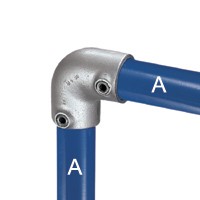
Those of you who have searched the Internet for industrial/plumbing pipe guides may have come across something known as Kee Klamps.  Kee Klamps are pipe fittings that use a presser screw to hold pipes in place rather than a threaded connection.  Maybe the picture below will explain it better.
Instead of a threaded socket, those two Allen-type screws are tightened to hold the pipes in place.  There are two major benefits to this type of connector.  The first is a wider variety of configurations.  One can layer and criss-cross pipes with Kee Klamps in ways that one can't with regular plumbing pipes.  The other advantage is no need for unions.  Whenever a plumbing pipe design forms a closed loop, such as a square or rectangle, a union is needed because one can't screw a pipe in at both ends at the same time.
As you could see if I hadn't drawn over it, this bookshelf is a closed loop and, hence, requires a union.  The hex nut inside the green circle is a union.  A union has 3 different threaded hex nuts.  The 2 on the outsides spin in different directions so pipes can be joined.  The middle hex holds the other 2 pieces in place.  A union is not necessary when using Kee Klamps.

There are two major disadvantages of Kee Klamps that I perceive, the first being that the pipes are held together with just a small screw rather than a large thread path.  This theoretically should have less holding power, although people have built parkour structures using Kee Klamps.  The second drawback is cost.  A 90° elbow of 1-inch threaded pipe costs $3.60 at Lowe's; the same size elbow to buy on-line costs $10.86.  This brings up the inconvenience of on-line ordering versus picking something up locally as well as the potential added cost of shipping.

All these things being said, I am currently not sold on the idea of using Kee Klamps instead of standard plumbing joints.

The pictures on the page appear smaller than they are.  To see them larger, simply double click on the picture.  Also, I always welcome your constructive criticism.  Click on the Comment link below next to the icon of a pencil; it may say "No" or have a number in front of it.

References:
"15 - 90° Elbow." Simplified Building. Simplified Building Concepts, 2010. Web. 18 June 2014.

"Parkour Structure at Miami Freerunning and Parkour Academy." Simplified Building. Simplified Building Concepts, 2010. Web. 18 June 2014.

Friday, June 13, 2014

clean black iron pipe

On handling black iron plumbing pipe in my Lowe's, my hands came away very black.  It seems black pipe comes covered in oil to prevent rust during shipping (Williams).  Being a novice at google-fu, I was unable to get much information on de-oiling the pipe.  Most projects that use black iron pipe don't include instructions for cleaning the pipe, and the loft bed project I am using for reference simply says, "after cleaning pipe." Here is what I have found to this point.

Steevo recommends mineral spirits, while bob15 recommends alcohol or parts cleaner.  Most of the other sites were about removing rust, removing the black oxidation, or cleaning meth pipes.  Of these suggestions, I am going to start with alcohol.
This is why you want to clean black iron pipe before using for furniture builds.  Don't want this getting on your sheets or pants, do you?
I chose rubbing alcohol from the local grocer because it is easier to obtain than running to the hardware store.
This is the pipe before cleaning.  I squirted a little rubbing alcohol on a paper towel and cleaned the outside of the pipe.  I did this four times in total.
This resulted in a nicely shiny grey pipe ready to be used to build furniture.  I further discovered that one should also clean the connectors (Ts, flanges, etc.) as well.

The pictures on the page appear smaller than they are.  To see them larger, simply double click on the picture.  Also, I always welcome your constructive criticism.  Click on the Comment link below next to the icon of a pencil; it may say “No” or have a number in front of it.

References:
bob15. "Removing coating from black iron pipe." General Garage Discussion. The Garage Journal, 10 Feb. 2013. Web. 13 June 2014.

Steevo. "Removing coating from black iron pipe." General Garage Discussion. The Garage Journal, 10 Feb. 2013. Web. 13 June 2014.

Williams, Jane. "Black Pipe Vs. Galvanized." eHow. Demand Media, Inc., 21 June 2013. Web. 13 June 2014.

Black vs Galvanized

Some of you may have a question as to what, exactly, are black iron and galvanized steel pipe and what the differences are.  Here is a short primer on the subject.

Black iron and galvanized steel pipes begin life as the same steel tubing, so their internal structure is pretty much the same, down to the interior and exterior dimensions.

Black iron pipe was used primarily for gas lines (Mooney).&nbps; Some say the black is paint (WayneL5), while other contend it is oxidation from forging (Williams).  Of course, that info is from forum posts, so I will not attest to the accuracy.  Galvanized steel is coated with zinc to deter rust (Superpages).  Neither of these pipes should be used for drinking water plumbing.

I always welcome your constructive criticism.  Click on the Comment link below next to the icon of a pencil; it may say “No” or have a number in front of it.

References:
Mooney, Ted. “What is Black Iron?” Hotline/Forum. Finishing.com, n.d. Web. 13 June 2014.

WayneL5. "What *is* black pipe?" General discussion. Fine Homebuilding®, 17 June 2006. Web. 13 June 2014.

"What is Galvanized Pipe." Superpages. Dex Media, n.d. Web. 13 June 2014.

Williams, Jane. "Black Pipe Vs. Galvanized." eHow. Demand Media, Inc., 21 June 2013. Web. 13 June 2014.

Tuesday, June 10, 2014

Slight change of plans

While developing the plans for my desk/workbench, I discovered something about my plumbing pipe loft bed plan.  It is going to be about 57 inches wide, which is confirmed by the dimensions of my main inspiration.  This will make it partially cover my bedroom window.  Therefore, I checked again with Better Sleep Council.  A twin mattress is only 38 inches wide.  With pipes, the frame will end up being about 42 inches wide.  This will leave the bedroom window uncovered for my desk/workbench.

The pictures on the page appear smaller than they are.  To see them larger, simply double click on the picture.  Also, I always welcome your constructive criticism.  Click on the Comment link below next to the icon of a pencil; it may say “No” or have a number in front of it.

References:
"Industrial Steel Pipe Bunk Bed." Restoration Hardware Baby & Child. Restoration Hardware, Inc., n.d. Web. 6 June 2014.

"Mattress Sizes." Sleep Resources. Better Sleep Council, n.d. Web. 3 June 2014.

Sunday, June 8, 2014

Practice makes furniture

While searching for plumbing libraries in the Sketchup 3D design software, I came across a black pipe shelving unit, pictured below.
It is an interesting unit with floating shelf design.  I am wondering if plumbing pipe is strong enough to hold the float.  However, this does give me an opportunity to test a few things, such as the need to use union couplers when completing a square.  Also, the design is very flexible.  I can make the bottom shelf, fill it with stuff, and then add another shelf above.  As I stack I can create front support if the tower begins to sag.

I am concerned about two things:  The fact that the shelves are 2x12s, and the potential cost.  2x12s are pretty thick and heavy.  This might be more support than is needed.  As for the cost, I can buy a set of shelves for $40 at the Big Lots.  Will the higher price tag of these shelves meet cost-benefit analysis?  Another thing I just realized the design does not state is what thickness of pipe to use.

As I am currently is a period of overtime at work, I may not be able to get to this project any time soon.

The pictures on the page appear smaller than they are.  To see them larger, simply double click on the picture.  Also, I always welcome your constructive criticism.  Click on the Comment link below next to the icon of a pencil; it may say “No” or have a number in front of it.

Software for my hardware

At this point, my 3D plumbing design software choices seem to be limited because I am using Apple products and am not willing to spend $1000 for software I will only use occasionally.  I came across a product called Sketchup, which is Apple compatible and has a free option.  Unfortunately, my Mountain Lion computer is on the fritz, and Sketchup is not compatible with my Snow Leopard computer.

Fortunately, I still have the Windows 8 computer I bought when I was going to be a professional tax preparer, although the Wi-Fi is not functional.  Using my Snow Leopard, I downloaded the .exe file to a thumb drive.  I used this to load Sketchup to the Windows 8, hoping the software did not require Wi-Fi access.  This operation was a success.  Hence, I searched the software's libraries for plumbing pipe so I wouldn't have to create each individual pipe from scratch.  Again, money becomes involved.  The maker of a pipeline drawing tool extension for Sketchup wants $199.  I guess that is fair, but I would rather spend my money on the pipes themselves.

The next question, then, is how much time am I willing to spend creating my own pipe pieces to assemble furniture inside the software.

The pictures on the page appear smaller than they are.  To see them larger, simply double click on the picture.  Also, I always welcome your constructive criticism.  Click on the Comment link below next to the icon of a pencil; it may say “No” or have a number in front of it.

Friday, June 6, 2014

Once upon a mattress . . .

In my previous post, I showed a picture of my current design inspiration.  It did, however, raise a question:  How high will I have to make the railings?  To figure this out, I went back to the Better Sleep Council website.  Unfortunately, they do not list thicknesses of mattresses.  A Google search lead me to an article that stated beds can be anywhere from 5 inches to 20 inches thick (Belleville).  To complete my design, therefore, I am going to have to buy the mattress and boxspring prior to completing the bed, though I should be able to begin the lower portion of the frame because the length and width do not vary.

The pictures on the page appear smaller than they are.  To see them larger, simply double click on the picture.  Also, I always welcome your constructive criticism.  Click on the Comment link below next to the icon of a pencil; it may say “No” or have a number in front of it.

References:
Belleville, Douglas. "What Is The Normal Thickness of a Mattress & Boxspring?" STLBeds. STLBeds, n.d. Web. 6 June 2014.

Great design template!

While searching for ideas for industrial-style window treatments, I came across this website with this picture for a pipe loft bed frame.
This bed sells for $1149.00; I think I can build something similar for less.  How much less remains to be seen.  However, this design is now my starting point for building my own pipe bed.

The pictures on the page appear smaller than they are.  To see them larger, simply double click on the picture.  Also, I always welcome your constructive criticism.  Click on the Comment link below next to the icon of a pencil; it may say “No” or have a number in front of it.

References:
"Industrial Steel Pipe Bunk Bed." Restoration Hardware Baby & Child. Restoration Hardware, Inc., n.d. Web. 6 June 2014.

Tuesday, June 3, 2014

Size matters

All of the industrial pipe bed frame plans I have come across use different mattresses, so they all give different pipe sizes.  Therefore, I need to figure out the size for required for a full-size mattress.

According to the Better Sleep Council (yes, such a thing exists), a full mattress measures 53 inches wide by 75 inches long.  I need to create, then, a mattress frame with those inner dimensions.  For support, I want both longways and shortways slats.&nbps; If I take a 72-inch pipe and add a corner coupling at the end, this will add another 3 inches to the length, so I get 75 inches.  This already gives me 3 inches on the short side, so I need another 50 inches.  A T coupling adds 1¾ inches, bringing me to 4¾ inches.  Place a 2-foot pipe on each side of the T, and I have a total of 52¾ inches.  I now have my longways support.

The next part is designing the shortways supports.  If I am using ¾-inch pipe, this gives me . . . wait a minute.  Is the ¾ inches the inner diameter of the pipe or outer diameter?  According to Utility Service & Supply, Inc., a ¾-inch pipe has an outside diameter of 1.05 inches, and a 1-inch pipe has an outside diameter of 1.32 inches.  I wonder if this will change my measurements.

What I really need to do is find 3D plumbing pipe modeling software.

The pictures on the page appear smaller than they are.  To see them larger, simply double click on the picture.  Also, I always welcome your constructive criticism.  Click on the Comment link below next to the icon of a pencil; it may say “No” or have a number in front of it.

References:
"Mattress Sizes." Sleep Resources. Better Sleep Council, n.d. Web. 3 June 2014.

"Pipe Outside Diameter Chart." Utility Service & Supply Inc. New Growth Advisors, 18 Dec. 2013. http://www.utilitysupplies.com/pipe-od-chart.htm. 3 June 2014.

Plain or plumbing pipe?

I investigated my bed project a little more, and I discovered there are two methods for assembling an industrial pipe bed frame.

One method is to use plain pipe and fittings.  In this method, the fittings are glorified clamps, so the bed gets clamped together using Allen wrenches instead of needing plumbing wrenches.  Also, pipes can be cut to the length needed rather than needing to figure out the number of pieces to get a 53-inch length of plumbing.  This results in a sturdier frame overall.  On reading through the Instructable for this style of bed, the frame is partially welded, so that defeats my purpose of making something that could disassemble and be carried in my Saturn Ion.
This is another style of pipe bed that uses couplers.  This one builds a wooden pallet, so it also is not the design I am looking for.
This picture, which does not provide detailed instructions, shows how to use this system to create a hanging support system.  It also mentions that this simple pipe frame cost the maker $500-$600 dollars.  Is that really what this project might end up costing?

However, these three designs do demonstrate that the plain pipe and clamp fitting method is viable.  In fact, I now have several sources for getting these couplings: McMaster-Carr, Grainger, and Hollaender.
The other method is to use threaded plumbing pipes, as done in my initial inspiration and the subsequently discovered loft bed plans (pictured above).  While I should be able to acquire most of the items needed for this style of bed at the Home Depot or Lowe's, the pipe is much smaller.  Some plumbing pipe beds use ¾-inch pipe; others use 1-inch pipe.  The coupling beds mentioned previously use 1½-inch pipes.  Also, the design of this bed uses ratcheting straps to support the box spring.  I'm not sure I like that.

What it boils down to, then, is what size of pipe I want to use and when to use couplings instead of plumbing pipes.  In my mind right now, I am looking at making the loft bed frame but making the coupling mattress support.  Now, I need to find out if the Lowe's will cut and thread pipe for me.

The pictures on the page appear smaller than they are.  To see them larger, simply double click on the picture.  Also, I always welcome your constructive criticism.  Click on the Comment link below next to the icon of a pencil; it may say “No” or have a number in front of it.

References:
DenVogel. "Aluminum Pipe Bed." Instructables.com. Autodesk, Inc., n.d. Web. 3 June 2014.

ladyada. "Pipe Dream Bed." Instructables.com. Autodesk, Inc., n.d. http://www.instructables.com/id/Pipe-Dream-Bed/?ALLSTEPS. 3 June 2014.

magicmex43. "Aluminum Pipe Bed Frame." Instructables.com. Autodesk, Inc., n.d. Web. 3 June 2014.

nerdologist. "Pipe Loft Bed." Instructables.com. Autodesk, Inc., n.d. Web. 3 June 2014.

willparks. "A Soft Industrial Pipe Bed Frame." Instructables.com. Autodesk, Inc., n.d. Web. 3 June 2014.

Monday, June 2, 2014

Pipe bed frame project

As I rebuild my life, I am thinking about the furniture I want for my apartment.  I don't want anything I cannot move myself, so everything needs to be collapsable.  While looking for a bed frame, I came across the idea of making it out of plumbing pipe.  Many people call this a steampunk look, but I prefer the industrial, as used by the plan's creator.  Here is a picture of his creation.
There are two problems with these plans.  First, if I wanted to use wood, I would make a wooden bed frame.  Second, this is for a queen mattress.  Before proceeding further, therefore, I need to get the dimensions of a full mattress, my preferred alone size.

By writing this blog, I came across something that might be an even better fit, as I want a loft bed.  It is this design, also posted on Instructables.
As a loft-style bed was always in my plans, I will incorporate this design with the other one to come up with a plan of my own.

The pictures on the page appear smaller than they are.  To see them larger, simply double click on the picture.  Also, I always welcome your constructive criticism.  Click on the Comment link below next to the icon of a pencil; it may say “No” or have a number in front of it.

References:
Dorkfish92. "A Soft Industrial Pipe Bed Frame." Instructables.com. Autodesk, Inc., n.d. Web. 2 June 2014.

willparks. "A Soft Industrial Pipe Bed Frame." Instructables.com. Autodesk, Inc., n.d. Web. 2 June 2014.